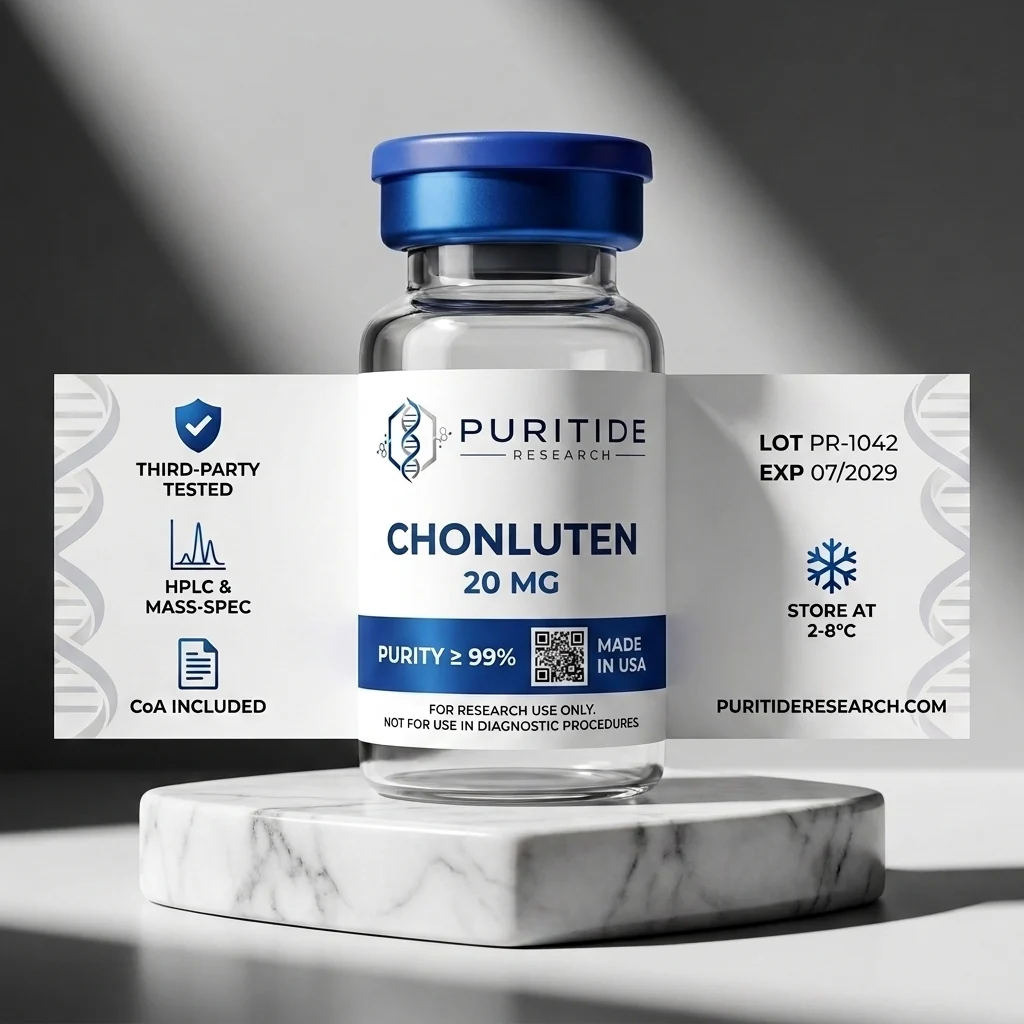
Chonluten is a synthetic tripeptide bioregulator (Glu-Asp-Gly) from the Khavinson family of short peptides, associated in research with respiratory and bronchial epithelial tissue. For teams studying tissue-specific gene regulation and pulmonary cell biology, it offers a minimal, well-defined model peptide. Puritide Research supplies Chonluten as a high-purity, research-use-only material, synthesized for in vitro and animal-model work and backed by third-party-verified certificates of analysis so your data rests on consistent, documented quality.
Product Specifications
- Application
- Respiratory epithelium and tissue-specific gene-regulation research
- Appearance
- Solid, white lyophilized powder in a sealed glass vial
- Chemical Formula
- C11H17N3O8
- PubChem SID
- 194641
- Molecular Weight
- ~319.27 g/mol
- Synonyms
- Chonluten, Glu-Asp-Gly, EDG tripeptide, T-34, bronchial peptide bioregulator
- Storage
- Store at ≤25°C, sealed, away from heat, light, and moisture. For extended storage, keep lyophilized and refrigerated or frozen.
Some analytical parameters have not yet been formally characterized for this research compound.
What Is Chonluten?
Chonluten is a synthetic tripeptide with the amino acid sequence Glu-Asp-Gly (EDG). It belongs to the class of short peptide bioregulators developed by Professor Vladimir Khavinson and colleagues at the St. Petersburg Institute of Bioregulation and Gerontology, a group that also includes Epithalon and Cortagen. Chonluten is the member associated in the Russian research literature with bronchial and respiratory epithelial tissue.
In experimental settings, Chonluten is used to investigate tissue-specific gene expression in respiratory epithelial cell populations, including stress-response genes such as those encoding heat-shock proteins and early-response transcription factors. As a minimal three-residue peptide, it serves as a model for studying how very short sequences may exert regulatory effects.
Present understanding of Chonluten derives from in vitro assays and animal models, largely from Russian academic sources, and observations should be interpreted within their experimental context rather than treated as established physiological or clinical outcomes. Puritide Research supplies Chonluten strictly for laboratory use; it is not approved for human or veterinary application.
Puritide Research supplies Chonluten strictly for laboratory research use. Not for human or veterinary use.
 Research Use Only