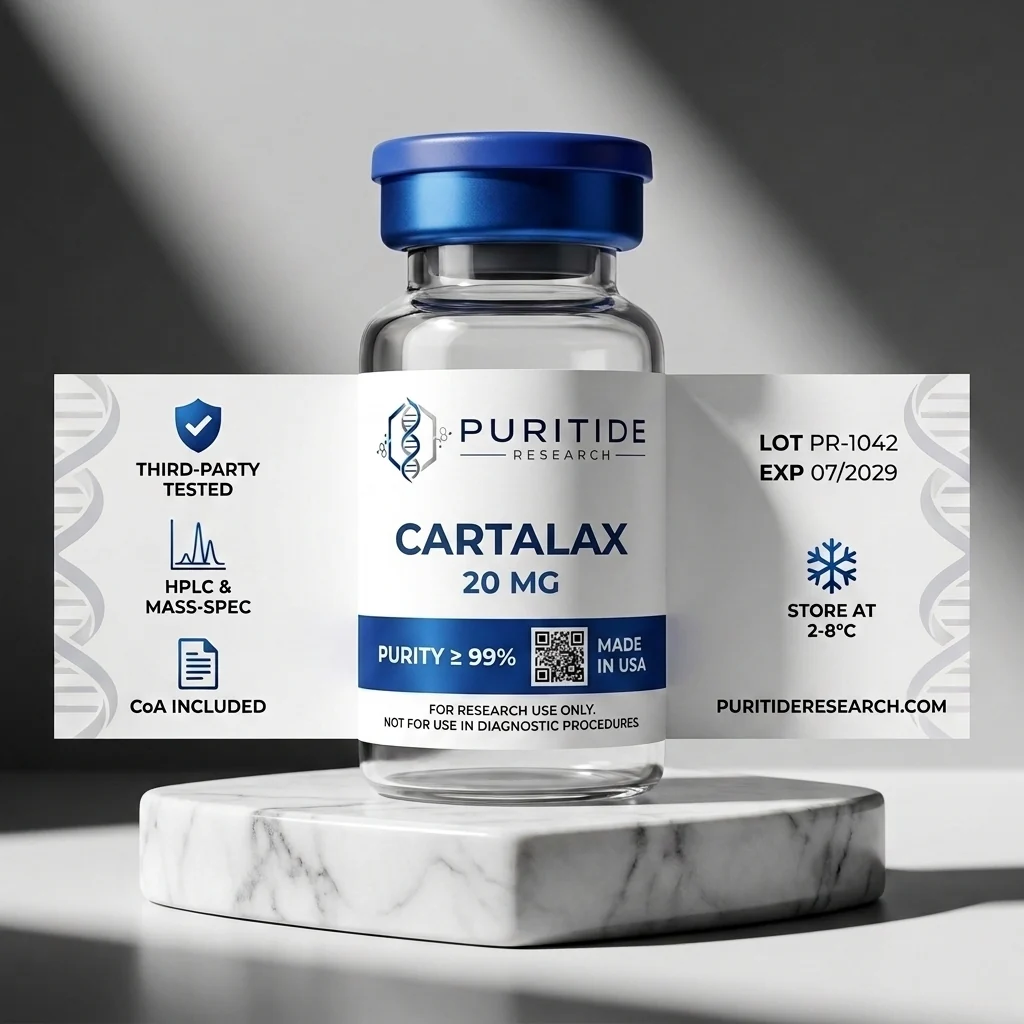
Cartalax is a synthetic tripeptide (Ala-Glu-Asp, AED) belonging to the family of short peptide bioregulators first characterized by Khavinson and colleagues. It was designed from amino acid sequences associated with cartilage tissue and is studied as a tissue-specific regulator of gene expression in chondrocyte-model systems. Puritide Research supplies Cartalax as a high-purity, research-use-only material, synthesized for in vitro and animal-model investigation and accompanied by third-party-verified certificates of analysis so your data rests on consistent, documented quality.
Product Specifications
- Application
- Cartilage-tissue short-peptide bioregulator research (gene expression models)
- Appearance
- Solid, white lyophilized powder in a sealed glass vial
- Chemical Formula
- C12H19N3O8
- PubChem SID
- 87815447
- Molecular Weight
- ~333.30 g/mol
- Synonyms
- Cartalax, AED, Ala-Glu-Asp, Alanyl-glutamyl-aspartic acid, cartilage tripeptide
- Storage
- Store at ≤25°C, sealed, away from heat, light, and moisture. For extended storage, keep lyophilized and refrigerated or frozen.
Some analytical parameters have not yet been formally characterized for this research compound.
What Is Cartalax?
Cartalax is a synthetic tripeptide composed of the amino acids alanine, glutamic acid, and aspartic acid (Ala-Glu-Asp, abbreviated AED). It is one of a series of ultra-short peptides, typically two to four residues, developed within the Khavinson school of peptide bioregulation, in which each peptide is associated with a particular tissue system. Cartalax is studied in the context of cartilage and connective tissue.
In experimental settings, Cartalax is used to investigate how short peptides may influence gene expression, cellular differentiation, and reparative processes in chondrocyte-tissue models. The proposed framework for this peptide class involves direct interaction of small peptides with DNA and chromatin, which researchers examine using cell-culture and animal-model approaches.
Present understanding derives from in vitro assays and animal studies, much of it published in the Russian-language literature, with limited international replication. Findings should be interpreted within their experimental context and not treated as established clinical outcomes. Puritide Research supplies Cartalax strictly for laboratory use; it is not approved for human or veterinary application.
 Research Use Only