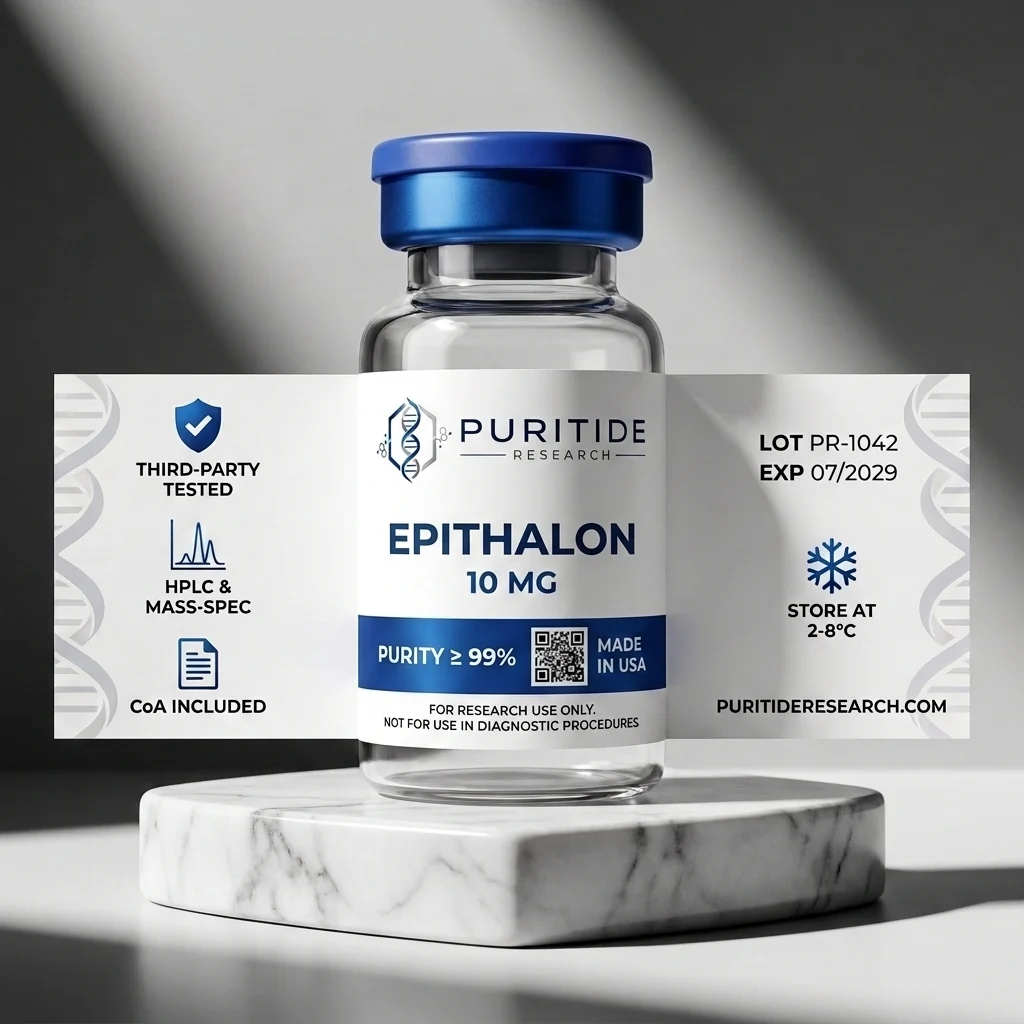
Epithalon (Epitalon) is a synthetic tetrapeptide derived from epithalamin, a peptide complex originally isolated from the pineal gland. For research teams studying telomere biology, cellular aging, and neuroendocrine regulation, it offers a compact, well-defined model compound from the Khavinson bioregulator lineage. Puritide Research supplies Epithalon as a high-purity, research-use-only material, synthesized for in vitro and animal-model work and backed by third-party-verified certificates of analysis so your data rests on consistent, documented quality.
Available Sizes
- ›Epithalon 10 mg Vial
- ›Epithalon 50 mg Vial
Product Specifications
- Application
- Telomere biology and cellular-aging pathway research
- Appearance
- Solid, white lyophilized powder in a sealed glass vial
- Chemical Formula
- C14H22N4O9
- PubChem SID
- 219042
- CAS Number
- 307297-39-8
- Molecular Weight
- ~390.35 g/mol
- Synonyms
- Epithalon, Epitalon, Epithalone, Ala-Glu-Asp-Gly, AEDG, AGAG tetrapeptide
- Storage
- Store at ≤25°C, sealed, away from heat, light, and moisture. For extended storage, keep lyophilized and refrigerated or frozen.
What Is Epithalon?
Epithalon (Epitalon) is a synthetic tetrapeptide with the amino acid sequence Ala-Glu-Asp-Gly (AEDG). It was designed by Professor Vladimir Khavinson at the St. Petersburg Institute of Bioregulation and Gerontology as a defined short-peptide analog of epithalamin, a natural pineal-gland extract, and is among the most extensively studied of the Khavinson peptide bioregulators.
In experimental settings, Epithalon is used to investigate telomere maintenance, telomerase activity, chromatin regulation, and neuroendocrine signaling associated with the pineal gland. Its small size and proposed ability to interact with DNA make it a compelling model for research on gene-expression modulation in cellular and animal systems.
Present understanding of Epithalon derives from in vitro assays, cell-culture models, and animal studies, and observations should be interpreted within their experimental context rather than treated as established physiological or clinical outcomes. Puritide Research supplies Epithalon strictly for laboratory use; it is not approved for human or veterinary application.
Puritide Research supplies Epithalon strictly for laboratory research use. Not for human or veterinary use.
 Research Use Only