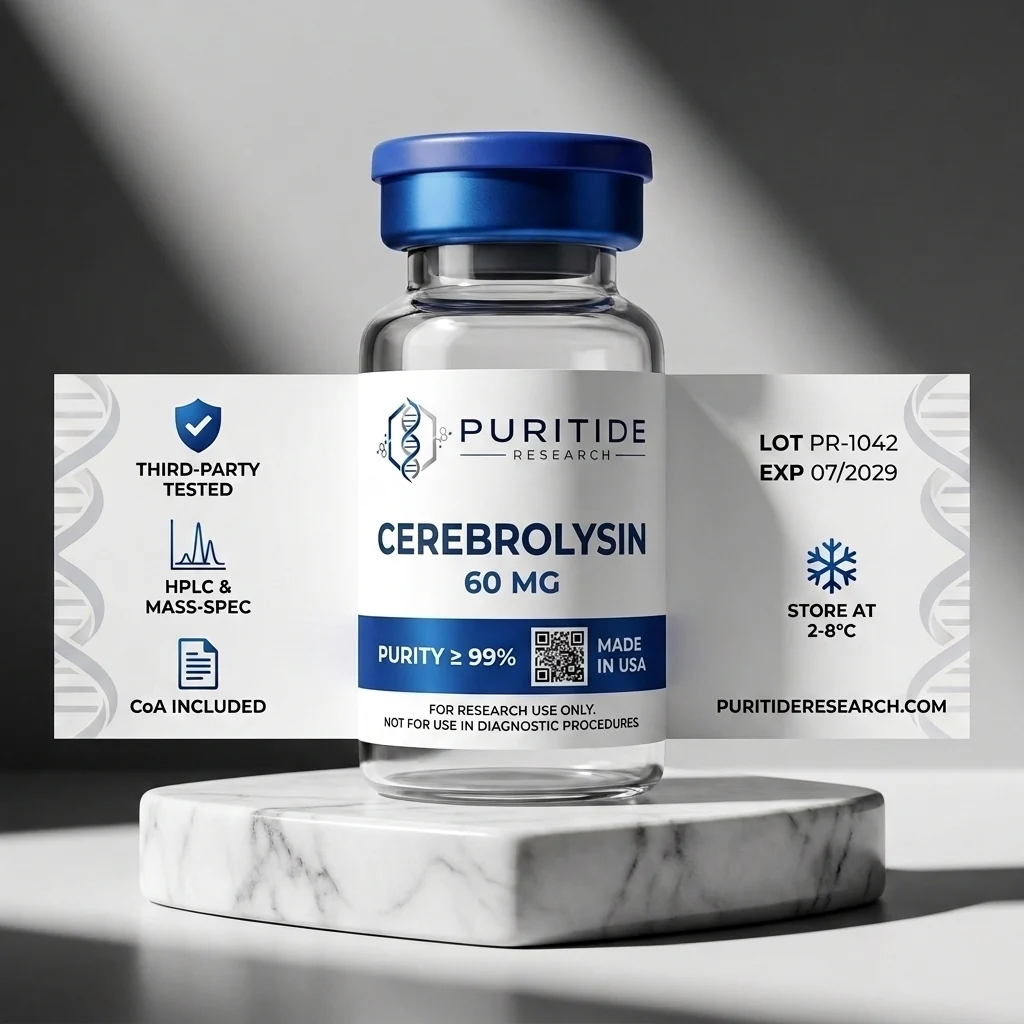
Cerebrolysin is a peptide preparation produced by the standardized enzymatic hydrolysis of purified porcine brain proteins, yielding a defined mixture of low-molecular-weight neuropeptides and free amino acids. For research teams studying neurotrophic signaling and neuroprotection, it offers a complex, biologically active model system rather than a single molecular entity. Puritide Research supplies Cerebrolysin as a research-use-only material, prepared for in vitro and animal-model work and accompanied by batch documentation so your data rests on consistent, characterized quality.
Product Specifications
- Application
- Neurotrophic and neuroprotection pathway research
- Appearance
- Solid or lyophilized peptide preparation in a sealed glass vial
- Molecular Weight
- Peptide fraction <10,000 Da; preparation is a mixture of peptides and free amino acids
- Synonyms
- Cerebrolysin, porcine brain peptide preparation, neurotrophic peptide complex, FPF-1070
- Storage
- Store at ≤25°C, sealed, away from heat, light, and moisture. For extended storage, keep refrigerated. Protect reconstituted or solution material from freeze-thaw cycling per internal validation.
Some analytical parameters have not yet been formally characterized for this research compound.
What Is Cerebrolysin?
Cerebrolysin is not a single compound but a standardized peptide preparation produced by the controlled enzymatic breakdown (proteolytic hydrolysis) of purified porcine brain proteins. The process yields a mixture in which roughly a quarter of the material by weight consists of biologically active low-molecular-weight peptide fragments and the remainder consists of free amino acids.
The peptide fraction is composed of fragments generally below 10,000 daltons, a size range often discussed in the literature in the context of biological activity and membrane permeability. These fragments are not identical to any single endogenous neuropeptide, but are studied for interactions with neuronal signaling pathways in ways that resemble or modulate the activity of endogenous neurotrophic factors.
Present understanding of Cerebrolysin derives from in vitro assays, animal models, and clinical research, and observations should be interpreted within their experimental context rather than treated as established outcomes for any given preparation. Because it is a biologically derived mixture, batch-to-batch characterization is central to reproducible research. Puritide Research supplies Cerebrolysin strictly for laboratory use; it is not approved for human or veterinary application.
Puritide Research supplies Cerebrolysin strictly for laboratory research use. Not for human or veterinary use.
 Research Use Only