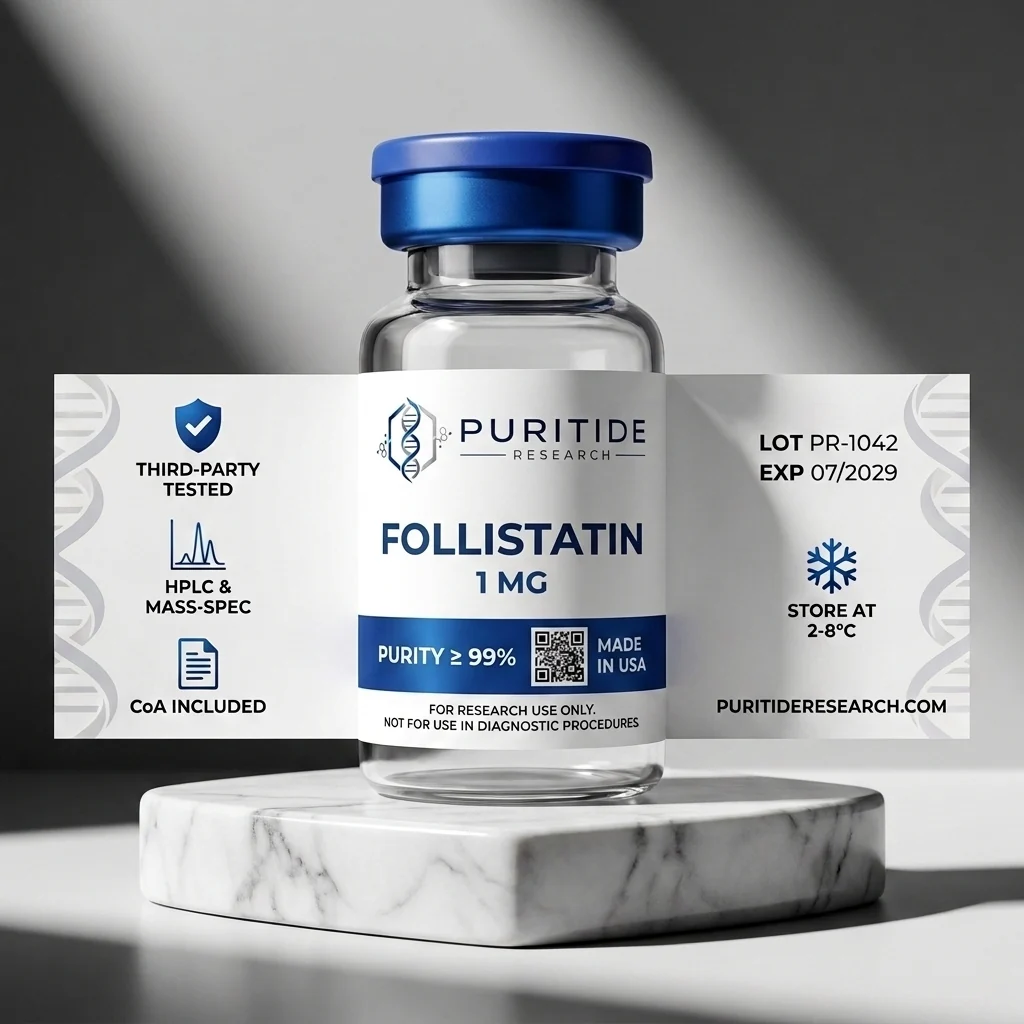
Follistatin is a secreted glycoprotein that acts as a high-affinity antagonist of the TGF-β superfamily, binding and neutralizing activins and myostatin (GDF-8). For research teams studying muscle biology, tissue growth, and growth-factor signaling, it offers a well-characterized endogenous regulator and a widely used model in myostatin-pathway investigation. Puritide Research supplies Follistatin as a research-use-only material, prepared for in vitro and animal-model work and accompanied by batch documentation so your data rests on consistent, characterized quality.
Product Specifications
- Application
- Myostatin / activin signaling and muscle-biology research
- Appearance
- Solid, white lyophilized powder in a sealed glass vial
- Molecular Weight
- ~34.8–38 kDa (FST-344 isoform; varies with glycosylation)
- Synonyms
- Follistatin, FST, FST-344, activin-binding protein, FSH-suppressing protein, myostatin antagonist
- Storage
- Store lyophilized at ≤ -20°C, sealed, away from heat, light, and moisture. After reconstitution, keep refrigerated and minimize freeze-thaw cycles per internal validation.
Some analytical parameters have not yet been formally characterized for this research compound.
What Is Follistatin?
Follistatin (FST) is a secreted glycoprotein encoded by the FST gene and produced by a range of tissues including liver, ovary, skeletal muscle, and pituitary. It functions as a soluble antagonist of the transforming growth factor-β (TGF-β) superfamily, binding target ligands with high affinity and preventing them from engaging their receptors. It was originally characterized for its ability to suppress follicle-stimulating hormone, which gives it its name.
Follistatin exists in several isoforms arising from alternative splicing and processing, including FST-288, FST-303, and FST-315; the circulating FST-315 form predominates, while research preparations are frequently based on the FST-344 sequence. Structurally, follistatin comprises an N-terminal domain followed by three cysteine-rich follistatin domains that together form the surface responsible for binding activins and myostatin.
In experimental settings, Follistatin is used to investigate the regulation of muscle mass, activin signaling, and TGF-β superfamily biology. Present understanding derives from in vitro assays and animal models, and observations should be interpreted within their experimental context rather than treated as established physiological or clinical outcomes. Puritide Research supplies Follistatin strictly for laboratory use; it is not approved for human or veterinary application.
 Research Use Only